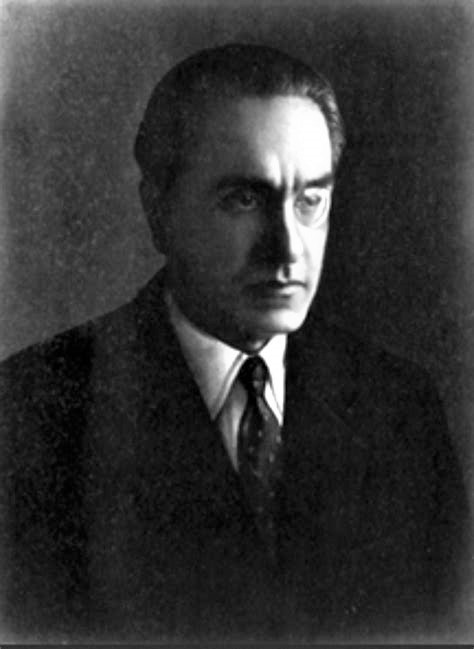
Julius Evola (1898-1974)
In the mid to late 1920s, Julius Evola- the Italian idealist, esotericist, and political philosopher- came up with a system he termed magical idealism. Magical idealism is so called because of its idealistic component and its esoteric component. Later on, Evola actually ended up becoming a full blown esotericist, but that is another story. Unfortunately, these books on magical idealism are some of the only books written by Evola that are not translated into English. Magical idealism is a metaphysical doctrine that has applications both to the arts (which Evola was involved in) and politics. In the arts, Evola was involved in the dadaism movement, which eventually grew into the surrealism of which Picasso and Dali were major figures. Here we give a description of magical idealism coming from Evola’s The Path of Cinnabar- an intellectual autobiographical book written when Evola was in his 60s.
Julius Evola in his magical idealism proves four fundamental metaphysical principles: (a) solipsism, (b) projection of the past from the present, (c) absolute freedom, and (d) oscillatory relationship between the subject and the physical world. We treat each in turn. (a) To advance past Fichte, Evola uses nondiscursive intuition. The world- like a dream- is full of creatures that appear real and even terrorize us, but are mere projections of our fancy. Thus there is nothing truly objective and which does not submit to one’s own conditionality- thus the world collapses into one’s own position. The “I” is thus a pure and detached “I” which is a pure being and an absolute form of self-evidence, and an absolute principle onto itself. The “I” becomes truth, action, and will. (b) As the only perception that exists, the past becomes a creation of the present moment. One sees a one-to-one correlation between the present circumstances and past events and it becomes equally likely that the present is creating the past than that the past is creating the present. Using nondiscursive intuition, one can come to the immediate certainty that he is creating the past. (c) the mind has the ability to act purely spontaneously in a matter unhindered by psychological considerations. Evola thus defines a type of freedom which is pure will, and which can unconditionally to choose both an option and the negation of that option; in other words, the “I” can choose both value and nonvalue as two equally available options. The I thus has an ability to act in a purely spontaneous manner free from existential and psychological deficiency; or rather to acknowledge the existence of this deficiency but render oneself superior to this deficiency and facing it and enduring all its weight. (d) I will later attempt to give a defense of this version of causality. However a mystery remains and that is how to explain the condition of “privation”, that is why the “I” initially does not experience itself as an absolute individual. This privation, however, exists only as a potentiality and has the power to unfold into something greater. This results in a dialectical procedure In which the individual transforms himself into the absolute individual. Thus, a thing is not true because it submits to the law of causality, but a thing is true because it has been wished. It is worthwhile here to note that Evola regards solipsism as transcending stoicism since it links the “I” to the world in such a way that the “I” cannot escape the world as his representation. The “I” here does not isolate himself from the world by opposing the value of his “I” to a lack of value in the world, for he is also responsible for the world.
Possible Involvement in Fascism and Further Considerations
In the 1920s, logical positivism was being used to outmaneuver the Italian public. Fortunately, what is in my opinion the culmination of modern idealism was reached in the works of Julius Evola; this was used as a radical method to confront reductionism. Evola is not typically associated as one of the forerunners of fascism, but I’m not sure, and actually I list Evola as one of the central figures. Evola’s works were written just years before the rise of Mussolini, although there may or may not be any direct written documentation of a carryover from Evola to Mussolini. Many modern scholars will equate reality with what is documented in writing, but I’m not so sure. Many times we see in the current society a philosopher come out and this trickles down into society and very often affects people without them knowing it. For example, one person directly reads the paper, and this carries over to his entourage, and that carries over to the next group of people, and pretty soon a person is affected without him knowing it. Thus from my perspective, it is impossible to know what philosophers were direct or indirect influences on a personality with any degree of certainty. Indeed there are philosophers such as Evola’s precursor, Fichte, who I believe actually had indirect influence on scientists such as Einstein. Indeed, it seems like the half-hazard way in which Mussolini got into power was through the use of the oscillatory relationship evoked by Evola, along with identicality of the intellect. I can very easily see how projection of the past from the present could have been used to counter the media at the time as well as the solipsism. It also certainly seems like Mussolini is invoking absolute freedom when he is at the podium stand. As such, I would certainly list Evola as one of the main precursors to fascism.
The oscillatory relationship is part rational and part irrational. One can set up a situation in which the world is a product of the mind with an I and not-I. There is thus a positing and a counterpositing explaining how the oscillatory relationship works; however, there is no way of knowing how this oscillatory relationship works beyond this, hence, resulting in an irrational component. It should be noted that the oscillatory relationship is metaphysical in nature and transcends the physical, i.e. stamina. In magical idealism, one sees something in the world go his way such as an event happening, and then when the forward progression is at its height he would notice something bad happen in world, and this transcends the body. This process indeed does not reduce to another person’s stamina either. The logical positivist attacks the philosopher on grounds that are very difficult to defend through second order experience. In fact, one could make the argument Evola would at the same time through his idealism reject principles such as stamina resulting in something quite different than what the ordinary man would experience. This phenomenon is alluded to in many movies from modern cinema.
Back To British and Continental Idealism; Back to Traditionalism
 Idealism Studies