Interpeting the Asuras

Revise

Eliade describes the Asuras as lawful and decisive and the devas as creative. Although this has validity, it should b e remembered that Mircea Eliade is Romanian and aligned with Russian orthodoxy. However many will believe the assures are guiding modern philosophy and not the devas. It generally seems like the modern period is assuring people that what they are doing is in the creation of new philosophies is correct. Another heuristic interprets the asuras and grandparents and the devas as parents. Al.so the assures can represent the early 1900s and the devas the 1800s. This can be sidstepped if we remember that the root of asura is assure which came about when the modern period was being developed. This can be sidestepped if we remember that the modern period was governed by idealism which tells them to proceed without there actually being a definitive truth, thus they probably took the assures to be assuring them. This says the Italians probably had a greater impact on the development of modern philosophy than expected since they are the ones who are asserting modern philosophy What the west is essentially telling you to worship wyour grandparents and not your parents. This allows society to proceed with a greater stedyness and give the youth more information to work on. This is in contrast to some Judaic interpretations.. We must remember that Mircea Eliade is Romanian which says that he is essentially being somewhat honest, giving an accurate description of reality and exerting himself and fudging the results Al little bit. Thus there is no guarantee that what Mircea Eliade is saying is correct

Mircea Eliade: The Religion of the Vedas

The entry of the Indo-Europeans is marked by destruction.  The documents mention ethnic groups such as Hittites, Mitanni; but Aryan elements are also mentioned. For more than a century, scholars have made efforts to identify the homeland of the Aryans such as in the Russian steppes, in central Asia, and Anatolia, but many today locate them north of the black sea. In terms of their migrations, they reached central Europe, the Balkans, Anatolia, and northern Iran in the second millennium, and the Mediterranean, northern Europe, and India in the 1st millennium. It is certain the origin of the Aryans is the neolithic, perhaps the Mesolithic. It also certain that the culture was influenced by civilizations of the near east.1

We can verify common structures of the common Indo-European religion. The earliest studies show the root deiwos, “sky,” in the terms designating god and in the names of the principal gods: Dyaus, Zeus, Jupiter. A certain number of gods are designated by thunder- Thorr, Perkunas. It is probable that the sky god was already yielding place. The cult of fire is also to be found such as the Vedic god Agni or the Slavic Ogni. The solar god also held a preponderant place, but has a checkered history among the Indo-Europeans, especially after contacts with the near east. The earth was vital energy opposed to the sky, but is more recent. They practiced sacrifice and knew chanting.  They had rituals in which they consecrated territories that they settled. They prohibited against using writing. A common heritage is not always recognizable because of the different cultural contacts during the migrations.2

Ideology and development in India

The various Indo-European mythologies have come down to us from different ages and documents of unequal value. Although we should avoid the errors of “comparative mythology,” a common Indo-European character can be inferred. Georges Dumezil has renewed the comparative study of Indo-European mythologies and religions. His works have demonstrated a common structure to Indo-European ideology- the division of society into three classes- priests, warriors, stock breeders and farmers. With the Indo-Iranian’s, we perceive the best tripartite division of society. And, indeed, in India we have the brahmanas, the kshatriya and the Vaisya. However, in Iran, this division did not harden into a caste system.  Similar tripartite divisions are found with the Celts the Romans. the division of the first function into complementary parts or tendencies can also be inferred.  Dumezil has also emphasized differences.  for example, the Romans think historically and juridically, whereas the Indians think in fable and mystically.3

The Aryans advanced into northwestern India in the second millennium and in a few centuries occupied the basin of the upper Indus. The invaders battled the dasyu of the Indus civilization. They are described as having black skin, and professing the cult of the phallus. They live in fortified settlements, which were ransacked. The dasyu were slaves but also seemed to be integrated into Aryan society. Symbiosis will increase as the Aryans advance toward the plain of the Ganges. The Aryans practiced agriculture but the economy was pastoral and the horse was reserved for raids. The Aryans love music and dancing and are fond of intoxicating drinks: soma and sura– the later having no religious meaning. The Vedic pantheon is occupied mostly by gods and not goddesses and when territory became occupied, they would dedicate an alter to Agni. The Vedic system consists of a priestley elite and a military aristocracy, but the public held beliefs later found in Hinduism.4

The Gods

In the Vedas, Dyas- the sky god- has already disappeared.  Dyas is soon replaced by Varuna. Varuna is designated by the name asura– a title possessed by others- i.e. Agni. The asuras are the ancient divine family.  The Vedic texts mention the opposition of the gods to the asuras– commented on in the post-Vedic brahmanas.  Agni- at Indra’s invitation- abandons the asuras since they didn’t possess sacrifice. Indra invited Varuna to his kingdom, and sent the dasyus into darkness.  This conflict opposes the young gods with the primordial divinities. However, the asuras were not necessarily the gods of the pre-Aryans.  The time of the asuras precedes the current epoch ruled by the devas. In India, the passage from a primordial epoch to the present epoch is explained in cosmogonic terms.5

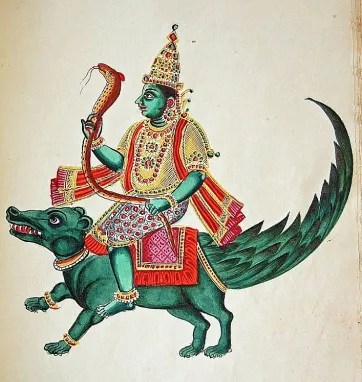
Varuna is sovereign, oversees the world, is omniscient, thousand eyed, no sin escapes him. Men are slaves to him; he is master of bonds and has the power to bind men at a distance and set them free.  He is represented with a rope in his hand and binds and ties, beginning with knots. Varuna is in decline in the Vedic period, but is connected to rta and maya. Rta means order- cosmic and moral. Varuna is brought up in the “house” of rta; to bear witness to rta. Varuna is responsible for those who break the law and reestablishes order. It seems paradoxical that the guardian of rta should also be intimately connected to maya. Maya means to change- destructive change that negates good mechanisms, but demonic and deceitful change. it is magic of the demonic type. The origin of philosophical mayacosmic illusion– is to be found in this definition since the definition is ambiguous.6

The union of opposites must call our attention; this is not peculiar to Varuna alone. The rig Veda terms Agni a “furious serpent;” Ahi Buha is invisibly what Agni is visibly; the serpent is a virtuality of fire whereas darkness is nonmanifested light. The Adityas are originally serpents- casting off their old skin, they achieved immortality and became gods, devas. The Satapatha Brahmana declares that “the knowledge of the serpents is the Veda”- a knowledge that at least in the beginning had a demonic character.  Mitra is secondary to Varuna- the sun is his eye; all seeing, nothing escapes him; with Mitra are Aryaman and Bhaga- who protect the society of the Aryans and share the wealth.  These four make up the Adityas or sons of the goddess Aditi.  The texts identify her with the earth or even the universe.7

Indra is the most popular god in the rig veda; he guides warriors, is fecundator, represents life, cosmic and biological energy. Indra fights Vrtra, the dragon, who held back the waters. This myth is naturalistic- losing hurricanes, pouring down rain, and causing wetness; but it is also cosmogonic- Indra, hurling vajra, tore apart Vrtra who caused sterility resulting from an immobilization of the waters. Indra burst the primordial monad by breaking the “resistance” and inertia of Vrtra. Other Indian myths explain creation from prime matter, but in this case, a world already existed. After this demiurgic defeat, Indra appointed Varuna as guardian of rta. This myth is also naturalistic and historical- it served the Aryans and inspired a mythico-ritual scenario. Indian speculation will soon use this myth to illustrate divine biunity and as an example of a hermeneutics seeking to unveil reality.8

The cult of domestic fire is important to the Indo-Europeans. In the Veda, Agni represents fire; however, he is not limited by this- for example, being the son of Dyaus, descendant from the sky, and is identified with the sun; Agni- god of sacrifice- is said to have fier spurts and have eternal youth- this makes his relationships with others more intimate than with other gods. Although god of sacrifice, Agni does not have considerable mythology- he is said to come from the mother and to have penetrated the waters; he is in the possession of clairvoyance. These meditations on heat are an Indian elaboration from prehistory; in later philosophical speculations, there is an elaboration and systematization of these meditations; Agni’s importance to the Indians is giving rise to meditations and speculations9

Soma– third in the Vedic pantheon- is friend of Indra; like Agni, it’s not easy to separate the ritual of the plant from soma himself. One of its only myths is its celestial origin- a bird took the plant from the mountains and brought it back to earth. The ritual of the plant is described in cosmic and biological terms. The texts emphasize ceremonies that precede and accompany the purchasing of the plant and the preparation of the drink. The virtue of soma is the ecstatic experience brought on by its ingestion. Soma stimulates thought, brings a sense of community, and certainty of “nondeath.” Its ingestion was confined to priests and some scacrifiers. Soma was a replacement for the original Indo-Aryan plant. Later, the experience of soma lead to meditation, orgys, yoga, and a series of philiosophoumena.10

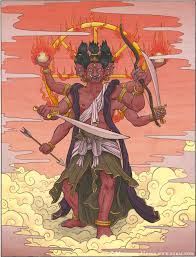
The Vedas mention certain gods which will slowly be forgotten or achieve unequalled position; among the former are Usas, goddess of dawn, Surya and Savitr, solar divinities, the Asvins, sons of Dyaus, and the Maruts, sons of Rudra; among the later are Rudra-Siva and Visnu. In the rig Veda, Visnu is kindly disposed towards men, friend of Indra, whom he helps against Vrtra; the brahmanas emphasize his relations with Prajapati. In the Upanishads, Visnu is exalted as supreme monotheistic god. Rudra is of the opposite type. He is not friend of men, disseminates sickness. Rudra wears his hair braided and his color is dark brown; his belly black and his back red.  He is armed with bow and arrow and haunts the mountains. Later, he becomes lord of wild beasts and protects those who shun Aryan society.11

Mircea Eliade on Myth and Reality

Only in Greece did myth submit to analysis from which it emerged demystified. attempts to interpret Greek myth are to some extent conditioned by the Greek rationalists. Homer was not a typical theologian or mythologist and it can be said exercised a literary genius. Here we do not give a full description of the process of erosion in which the Homeric myths and gods were stripped of their original meanings. Thales revolted against the Homeric idea that Gods inhabited only certain regions of the cosmos. Xenophanes does not attack the pantheon but does not believe that the gods can move from place to place.  He rejects the immorality of the gods. Later, the critiques attempt to free the concept of divinity from the anthropomorphism of the poets. What was now sought was their hidden meanings. Theagenes suggested that the names of the gods represented the natural elements. Chryssippus reduced the Greek gods to physical or ethical principles Euhemeruis believed the gods were ancient kings deified. The Christians later took a stand to demonstrate the unreality of the Greek gods. The Greek myths are known only as literary works and are not seen in a cult context. The living side of Greek thought escapes us. However not all mythical thought was disregarded- i.e. the mystery religions.1

Mircea Eliade vs Guenon

Mircea Eliade claims that the Greeks took Homers work to be a work of Fiction. This relies on his critique of the Greek rationalists. Many people today will take what Mircea Eliade is saying to be fact- why? Because Mircea Eliade is Greek and the Greeks are gods. However, they overlook that fact that Mircea Eliade is leaving in a hint that What he is saying might not be true. The Greeks actually believed what Homer wrote was real. Why? Because along Guenonian lines it was handed down orally for a hundred years. This is very important because it says that a group of people at one time in history believed something to be true which upon inspection today turns out to be completely false. The same goes for certain myths of the Persians and Indians. Fiction is in fact a modern invention- instantiated by Descartes and made fully explicit by Fichte

Berkeley on Abstract Ideas

Revise

Locke believes words signify thing by signifying ideas. Ideas intervene between words and the world and their intervention determines what in the world the words refer. On Berkeley’s account of Locke, a word signifies a class of things because the intervening idea is somehow abstract or general in its own right. General words come to be made by being made the signs of general ideas which in turn become general by being separated from ideas that are linked to a particular existence. In this way they can represent more individuals than one each having conformity to the abstract idea. But this is suspicious to Berkeley because it is difficult to see what this idea would be like. For example, with the general idea of man, it cannot represent a particular man because that idea has already been assigned. Since a word must be fully determined by the associated idea allowing an idea to represent sometimes a particular and sometimes a general result in a looseness of fit between ideas and the world. Thus, the idea of a general man must be the product of some kind of mental manufacturing. For example, the idea of a general man must have color and shape but it cannot have a particular color and shape without endangering its generality. Because there cannot be abstract images, there cannot be abstract ideas. A similar problem arises for colors. A specific color such as scarlet cannot be abstracted from its shape therefore there are no general colors.1

A general idea can be seen as a separation of the general quality of manhood from specific qualities of individual men thus a general idea is actually a complex of ideas. Each of the ideas in the complex will be general rather than specific. In abstracting the general quality we separate each of the general qualities from the specific qualities falling under them.  We form a number of abstract ideas and keep t5hem together in a cluster separated from specific qualities but not from each other. Berkely thinks this calls for an image it is beyond our capacity to form. Few contemporary philosophers have been convinced by this argument. His argument will miss the mark if we think of ideas in another way. Berkeley’s failure is a personal one and if we cannot conceive of a general idea, we must confess to inattention. Yet these complaints are less important and Berkeley’s argument goes deeper than it.2

Argument and Objections

Abstraction is the belief the mind can separate what is common and alike in objects considering apart and separating out that which is common and alike in all forming an abstract idea. This is a process of generalization. For example, a person sees multiple people and separates out from them the general idea of man. In Berkeley’s argument against abstraction, consider the idea of a triangle. This involves the separation of triangularity- the complex of qualities triangles share- to the inessential qualities some triangles have and others lack.  Clearly, triangularity occurs whenever triangles do. However, the question is whether triangularity can exist by itself. Berkeley believes this is not true, claiming that all entities are particular. Berkeley is contrasting his position to the position of Locke. It follows that the content of our thinking is determined by the idea we confront in thought. Therefore, there is no way of distinguishing between conceiving nothing but triangularity and conceiving of the separate existence of triangularity. It follows that forming the separate existence of triangularity is impossible. Since what is impossible is inconsistent, and what is inconsistent cannot be conceived, it follows that there is no such thing as abstract ideas.3

It can be objected that god really can create the abstract ideas that Berkeley expounds. Berkeley thinks abstract ideas are, like four sided triangles, inconsistent. But Wrinkler believes abstract ideas are different.  The idea of a particular triangle is consistent, so how can we come up with something inconsistent simply by removing a certain part of it? Wrinkler believes Locke accepts every premise in Berkeley’s case against abstraction. However, the argument depends for its success on a suppressed premise. Locke makes the distinction between conceiving of nothing but triangularity and conceiving of its separate existence. Thus, Locke sees abstraction as selective attention- the abstract idea of a triangle involves looking at different triangles and focusing on what they have in common.  To conceive of triangles as selective attention is to deny the content assumption– the assumption that the content of thought is determined by its object. On the view Wrinkler is suggesting may be Locke’s, we think of one triangle or triangularity in general depending on how much of the idea we attend to. So Berkeley’s argument only succeeds ad hominem in that it attacks not any position but the position of a concrete opponent. Several scholars have argued that Locke conceives of abstraction as selective attention.4

Analysis

First, I want to say that Berkeley conceiving of abstraction as selective attention is a much milder form of abstract ideas than most versions. Thus it is more permissible than other variants. Secondly, I deny that Locke actually accepts every premise that Berkley endorses or that Locke actually denies the content assumption. These innovations are probably more recent and reflect the construals of analytic philosophy. Thirdly don’t believe the content assumption can be denied. For suppose you are abstracting in the sense of focusing on what different triangles have in common. If you are doing that you are either focusing on the original triangle or you are superimposing an additional triangle on top of the original triangles. In order to abstract the triangles you must picture an entirely different triangle in which case you are adding a specific color to that triangle just as the original triangles. There is no such thing as sele3ctive attention any selective attention requires a completely seperate image which requires its own unique colors and traits.

Berkeley

Lainson’s description of Ahriman

The plan of Ahriman is to mechanize all of creation. Steiner placed the incarnation of Ahriman shortly after the year 2000. People must choose whether they will pull themselves up from the abyss or whether they will choose to sleep and let evil pass by unnoticed. Technology feeds on the soul and one can become apathetic to Ahrimanic entrapment brought through technologies of all kinds. At this time, 2021, the incarnation of Ahriman may be very near. This second death may result in a complete severance from the spiritual worlds. Man and machine could merge coupled with an explosion in machine intelligence and expansions in gene research and nanotechnology. This will result in a lack of distinction between the biological and the mechanical or between the physical and the virtual. With these innovations, the bodies limitations will be transcended and illness will be eradicated. We will be able to manufacture any physical product on demand and hunger and poverty will be solved. Going beyond virtual reality, new technologies assisting Ahriman will be developed. Virtual reality will be eclipsed by augmented reality. People will be drawn into Ahrimanic Maya.1 Elsewhere in the book, Lainson mentions the beast’s mass biological manipulation of food products.

On the Beast

I do not regard Hitler to be the beast. Perhaps he was the beast, but he probably was a very mild version of the beast. I see the Nazis as revolting against freemasonry and anthroposophy mainly do to the monetary inequalities and the technology. Nazism was correct in theory but incorrect in implementation. The pragmatics were done out of necessity. The Nazis didn’t have an issue with the idealism but the reductionism. The natural spiritual development got cut off with national socialism but some of the spiritual developments were technologically motivated. That’s the Nazis reason for reacting against freemasonry and anthroposophy. Other organizations have alternative reasons for the reaction. Schellings organic idealism by itself is not necessarily a bad development. If watered down and handled correctly, his organic idealism is not the worst thing in the world.  

Anthroposophy

On the Types of Occultism

In her book The Circle of Twelve and the Legacy of Valentine Tomberg, Claudia Mclaren Lainson gives her description of the three occultisms. Occultism- that comes across to me as an Western invention, not to be of concern to Easterners. But lets go ahead with it anyways.

Through the Christian rosenkreutz, the founder of the Rosicrucian order, came the origin of the three occultisms.1 The three occultisms are eugenic, hygienic, and mechanical. Tomberg placed Zarathustra under eugenic occultism, but I have a suspicion that Steiner placed Zarathustra under mechanical occultism. The union of the temple created a bridge between eugenic and hygienic occultism. Petrine Catholicism is associated with eugenic; Pauline Protestantism with hygienic, and Johannine orthodoxy with mechanical. We may further associate Moses with eugenic, Abraham with hygienic, and Elijah-john being with mechanical. Eugenic is associated with truth/law, hygienic with goodness/love, and mechanical with beauty/power. Eugenic is further characterized by thinking, hygienic by feeling, and mechanical by willing; These three occultisms can be associated with the trinity. Separate from these are red occultism corresponding to imagination/truth, white corresponding to inspiration/goodness, and blue occultism corresponding to intuition/beauty. That’s funny because I distinctively remember this being yellow occultism. White occultism is really yellow occultism in disguise. Maitreya is working to bring these occultisms together.

On the Supremacy of Eugenic Occultism

Instead of attempting to raise the dead through mechanical methods, perhaps it is best to bring Saoshyant to the earth through other methods such as with drugs. Rather than someone on this planet bringing the dead back to life through mechanical methods- the mechanical occultist interpretation- perhaps through the use of drugs, Saoshyant can be called down to the earth. Religious people have been having theophanies and so forth for many years and there is no reason for this to stop. By cutting off the drug flow you may be cutting off access to the divine. On the other hand, I am still a fan of the German idealist interpretation of the end times. Perhaps with Schelling’s organic idealism, global warming, and so forth- a disease of some sort will bring the dead back to life. There are some indications in the scientific lore that this may be possible. Is eugenic occultism only one type of occultism along with mechanical for example? I’m not so sure. There can be only one truth and everything else is a deviation. My doctrine can perhaps be regarded to be a type of occultism since it is leaping into the transcendent and not appealing to previous esotericisms. But perhaps it would be more appropriate to label this doctrine magical- outside of Steinerian analysis. Further, it can perhaps be argued that this is the way things always were.  

Anthroposophy

Mircea Eliade: The Religion of the Israelites

The religion of Israel is supremely a religion of the book- the corpus made up of texts of different ages representing oral traditions of considerable antiquity but revised over the course of several centuries. Some authors maintain that cosmogony and origin myths play a secondary part in the religion of Israel. In short, the Hebrews were more interested in sacred history than in mythical events primordium. This may be true to a certain extent, but there is not any reason to conclude that the ancestors of the Israelites had disregarded these issues. Genesis begins with God creating the heavens and the earth and organization from chaos. He said “let there be light” and the successive stages of creation are accomplished by a divine word. The biblical account presents a specific structure: creating of a world and a world that is good. In another account, God fashioned Adam and created Eve through one of Adam’s ribs. The creation of woman from a rib from Adam can be interpreted as indicating the androgyny of the primordial man.1

The Garden of Eden and the Flood

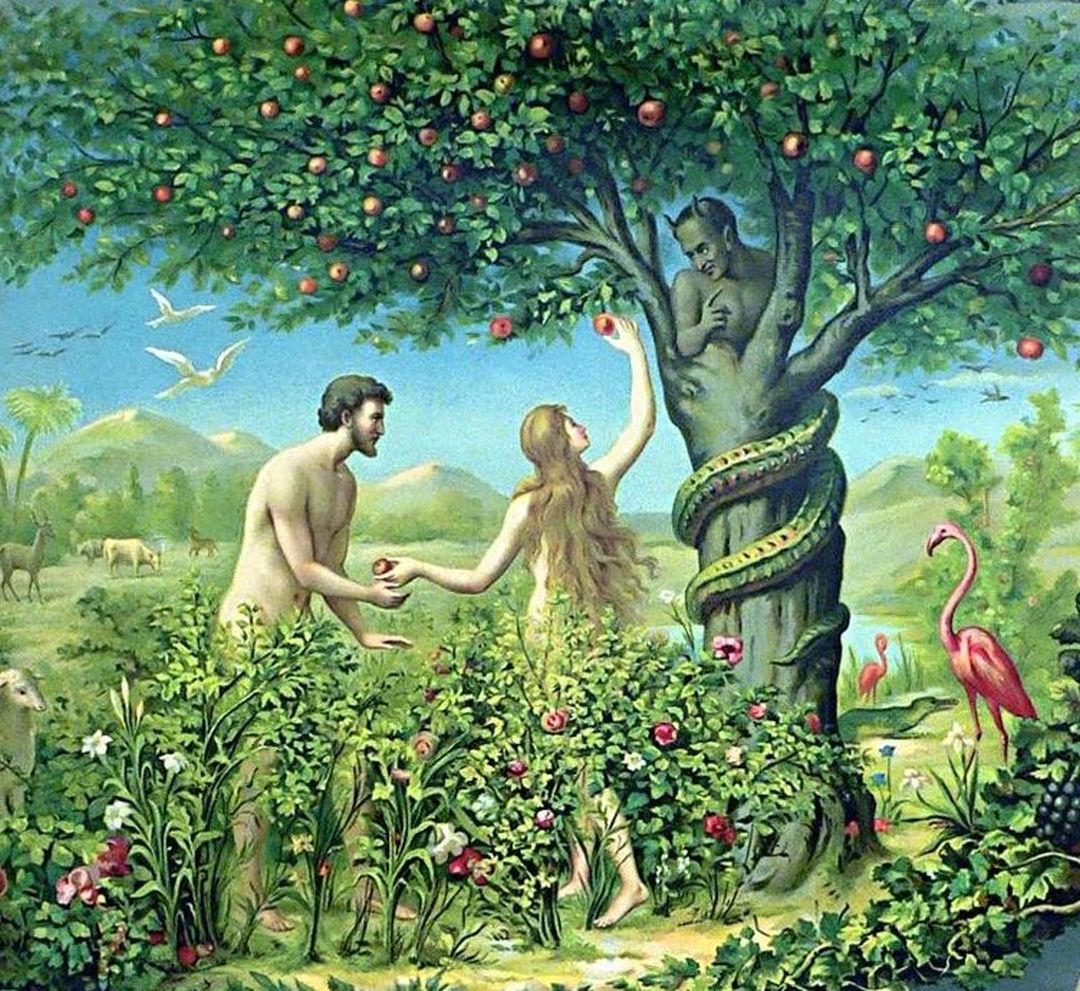
The tale of Adam and Eve and the garden of Eden has parallels with the Mesopotamians. This myth tells of an original paradise which is situated at the center of the world. Yahweh gives the commandment that all trees may be eaten except for one. However, the serpent succeeds in tempting Eve. God banishes the couple from paradise and condemns them to work for a living. Adams initiatory failure gave rise to the notion of “original sin” a central concept of Hebrew and Christian theologies and enforces the authority of Yahwistic monotheism. This first sin brought about the source of all evils that burden humanity. Eve gave birth to Cain a “smith” and Abel a “shepherd.” They gave their offerings and Yahweh accepted Abel’s over Cain’s. Angry, Cain killed Abel. Now Yahweh accursed Cain and drove him from the ground making him a wanderer of the earth. This myth reflects the simple and pure existence of nomadic herders and their resistance by dwellers in towns.2   

The descendants of Cain and Seth lived very long lifespans- 800 or 900 years in length. Similar ideas are found in Greece and India with the age of heroes. After a certain time, their lifespans were shortened to 120 years. The greatest event of this period was the flood. Noah built an arc on Yahweh’s instructions and built it with representatives of the animal species. Only Noah, his wife, and his sons were saved. In these myths, a flood is sent to destroy the world so that humanity can be recreated and restored. The ancestors of Noah decided to build a tower with “its top reaching heaven”- the last incorrect maneuver. Yahweh came down and concluded that there will be nothing to hard for them to do and confused their language and scattered them over the earth. The redactors of the torah preserved a mythology of the traditional type but reinvented to form a new religious vision. This was transformed into a “sacred history” to an extent previously unknown.3

The Period of the Patriarchs

The latter half of Genesis involve the adventures of Abraham and Isaac and constitutes the period of the patriarchs. This period has been criticized as being fictional but some have been inclined to accept the reality of this tradition. Whether they are donkey breeders or caravanners, this text shares certain analogies with the institutions of the near east. This half of Genesis introduces a new religious experience which will become the religious experience peculiar to Judaism and Christianity. God lays down a series of instructions and makes a series of promises. The religion of the patriarchs is the cult of the father. He binds himself to a group of men who he binds and protects. On entering Canaan, the patriarchs were confronted by El of whom they identified with him which says there may have been structural similarities between the two. The patriarchs offered sacrifices, built alters, and set up stones; they also offered blood sacrifices.4

One ritual that was important to the Israelites involves dividing a heifer, goat, or ram in two- which has analogies elsewhere. But the main sacrifice found in Genesis is the sacrifice of Isaac. God demanded that Abraham sacrifice his son Isaac as a burnt offering; but when he was preparing the ordeal, a ram was substituted for him. This has been criticized as an idealization of history since the Canaanites had a similar procedure; but in the context of Genesis, the writers were more concerned with faithful transmission of tradition than with idealization. This episode illustrates more forcefully than any other in the old teastemant the meaning of Abrahamic faith. Abraham did not prepare to sacrifice his son for some purpose but simply based on faith even though he did not know why. However, Abraham never doubted the sanctity, perfection, and omnipotence of his god.  Here we are presented with the dialectic of the “profane” being transmuted into the “sacred.”5

Moses and the Departure from Egypt

The beginnings of the religion of Israel are related to Genesis 46-50, Exodus, and the Book of Numbers. This includes the settling of Jacob in Egypt, the persecution launched by the pharaoh, the ordeals of Moses, his flight into the desert, the appearance of a “burning bush,” his mission laid out by God, the ten plagues sent by God, the departure of the Israelites and the crossing the sea, the theophany at mount Sinai, the forty years journeying in the desert, the conquest of Canaan under Joshua. Criticism has been made to separate the historical events in these sources from the mythological. certain events have been fitted with definitive dates but it has not been possible to recover the historicity of some of the most important events. There is no reason for doubting that Moses existed but many biographical details escape us. In any case, he follows the model of others in the age of heroes. The name Moses is Egyptian and perhaps of African descent.  It is possible that Moses knew of the reform of Akh-en-aton, The departure from Egypt seems to reflect a historical event but perhaps construed with mythological excrescences.6

While keeping sheep for his father-in-law, Moses crosses the desert and comes to a mountain. He sees a fire coming from a bush and hears a voice claiming to be God. He declares to be the god of Abraham but Moses senses he is in the presence of something unknown. He reveals his mode of being but does not reveal his person. All Hebrews today accept him to be the god of Abraham. However, this god is likely to be a pure Yahwism. On the other hand, there are some indications of Yahweh merging with the god of the father. What is involved may not be pure monotheism since the existence of other gods is not denied. However, the struggle against false gods begins. Yahweh is conceived as anthropomorphic. He displays qualities and faults that are specifically human but does not reflect the human situation. The contradictory nature of some of these attributes aligns him with some of the divinities from Hinduism, for example. After the departure from Egypt the theophany took place on the mountain of Sinai. Yahweh dictated the laws of the covenant and gave Moses the two tablets.  Nothing definite is known about this cult but may have shared similarities with preIslamic Arabs.7

The Religion of the Judges and Syncretism

The period from 1200 BC between when Moses entered Canaan and Saul was proclaimed king is known as the age of Judges. The judges were military leaders councillors and magistrates. Yahwism is accepted into other tribes and the Canaanite religion is absorbed into Yahwism. But also, during this time period, Yahwism evolves and changes. In consequence of the association Yahweh-El a number of Canaanite sanctuaries are consecrated to Yahweh. There was also a confusion between Yahweh and Baal.  Part of the Canaanite sacrificial system was adopted. Sanctuaries are built on Canaanite models including massebahs (standing stones) and asherahs (wooden posts symbolizing Asherah). Among the ritual objects, we find teraphim (images or masks). The cult was organized around sanctuaries containing priests and next to them diviners or seers. Israeli ecstatic prophecy was deeply rooted in Canaanite religion. Even during the conquest there was a Canaanite influence even though the prophets lay claim to the purest Yahwism.8

Mircea Eliade

Evola on the Fall of Rome

According to Evola, the world will not end as long as the Roman empire exists.1 This is in contrast to Coomaraswamy who believes it is the Greek philosophy that must be returned to. For perhaps by returning to this philosophy, the “cosmos” will be restored through a restoration of the proper “supernatural” forces. Or perhaps the people’s imagination will shift the world back into a state of harmony. It is difficult to say anything for sure on this point except that all scientific developments would have to be simultaneously removed and there would be nowhere to turn for the rest of time. The other interpretation either relies on nonexistent forces or subliminal, modern forces and it is diifcult to say anything decisive on this point there again being no direction to turn for the rest of time.

Global warming is part of the Holy Roman Empire- with neutral monism. There are three forces according to neutral monism- the scientific, the philosoph8ical, and the religious- and the scientific or philosoph8ical force- whichever one you decide it is- may be partly or entirely responsible for what is going on. The religious force such as God creating natural disasters may not be the only cause and could remain in effect if the philosophical force is removed. At the same time, you don’t want to remove any philosophical force in existence unless it is 100% necessary. Once the philosophical forces start getting removed, all of the philosophical forces may start dropping off. It may have to be removed, but that has to be decided by the sciences as guided by the church and the church- a just church- has to ultimately decide whether Schelling’s organic idealism should be removed.  Indeed, there could be some benefit to letting the planet burn up just a little bit. It can be argued that the idealism of the moderns is a Bona fide force deriving from the Indians.

Traditionalism