The entry of the Indo-Europeans is marked by destruction. The documents mention ethnic groups such as Hittites, Mitanni; but Aryan elements are also mentioned. For more than a century, scholars have made efforts to identify the homeland of the Aryans such as in the Russian steppes, in central Asia, and Anatolia, but many today locate them north of the black sea. In terms of their migrations, they reached central Europe, the Balkans, Anatolia, and northern Iran in the second millennium, and the Mediterranean, northern Europe, and India in the 1st millennium. It is certain the origin of the Aryans is the neolithic, perhaps the Mesolithic. It also certain that the culture was influenced by civilizations of the near east.1
We can verify common structures of the common Indo-European religion. The earliest studies show the root deiwos, “sky,” in the terms designating god and in the names of the principal gods: Dyaus, Zeus, Jupiter. A certain number of gods are designated by thunder- Thorr, Perkunas. It is probable that the sky god was already yielding place. The cult of fire is also to be found such as the Vedic god Agni or the Slavic Ogni. The solar god also held a preponderant place, but has a checkered history among the Indo-Europeans, especially after contacts with the near east. The earth was vital energy opposed to the sky, but is more recent. They practiced sacrifice and knew chanting. They had rituals in which they consecrated territories that they settled. They prohibited against using writing. A common heritage is not always recognizable because of the different cultural contacts during the migrations.2
Ideology and development in India
The various Indo-European mythologies have come down to us from different ages and documents of unequal value. Although we should avoid the errors of “comparative mythology,” a common Indo-European character can be inferred. Georges Dumezil has renewed the comparative study of Indo-European mythologies and religions. His works have demonstrated a common structure to Indo-European ideology- the division of society into three classes- priests, warriors, stock breeders and farmers. With the Indo-Iranian’s, we perceive the best tripartite division of society. And, indeed, in India we have the brahmanas, the kshatriya and the Vaisya. However, in Iran, this division did not harden into a caste system. Similar tripartite divisions are found with the Celts the Romans. the division of the first function into complementary parts or tendencies can also be inferred. Dumezil has also emphasized differences. for example, the Romans think historically and juridically, whereas the Indians think in fable and mystically.3
The Aryans advanced into northwestern India in the second millennium and in a few centuries occupied the basin of the upper Indus. The invaders battled the dasyu of the Indus civilization. They are described as having black skin, and professing the cult of the phallus. They live in fortified settlements, which were ransacked. The dasyu were slaves but also seemed to be integrated into Aryan society. Symbiosis will increase as the Aryans advance toward the plain of the Ganges. The Aryans practiced agriculture but the economy was pastoral and the horse was reserved for raids. The Aryans love music and dancing and are fond of intoxicating drinks: soma and sura– the later having no religious meaning. The Vedic pantheon is occupied mostly by gods and not goddesses and when territory became occupied, they would dedicate an alter to Agni. The Vedic system consists of a priestley elite and a military aristocracy, but the public held beliefs later found in Hinduism.4
The Gods
In the Vedas, Dyas- the sky god- has already disappeared. Dyas is soon replaced by Varuna. Varuna is designated by the name asura– a title possessed by others- i.e. Agni. The asuras are the ancient divine family. The Vedic texts mention the opposition of the gods to the asuras– commented on in the post-Vedic brahmanas. Agni- at Indra’s invitation- abandons the asuras since they didn’t possess sacrifice. Indra invited Varuna to his kingdom, and sent the dasyus into darkness. This conflict opposes the young gods with the primordial divinities. However, the asuras were not necessarily the gods of the pre-Aryans. The time of the asuras precedes the current epoch ruled by the devas. In India, the passage from a primordial epoch to the present epoch is explained in cosmogonic terms.5
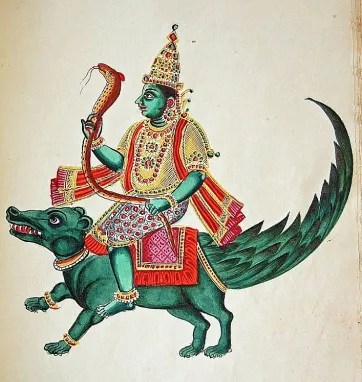
Varuna is sovereign, oversees the world, is omniscient, thousand eyed, no sin escapes him. Men are slaves to him; he is master of bonds and has the power to bind men at a distance and set them free. He is represented with a rope in his hand and binds and ties, beginning with knots. Varuna is in decline in the Vedic period, but is connected to rta and maya. Rta means order- cosmic and moral. Varuna is brought up in the “house” of rta; to bear witness to rta. Varuna is responsible for those who break the law and reestablishes order. It seems paradoxical that the guardian of rta should also be intimately connected to maya. Maya means to change- destructive change that negates good mechanisms, but demonic and deceitful change. it is magic of the demonic type. The origin of philosophical maya– cosmic illusion– is to be found in this definition since the definition is ambiguous.6
The union of opposites must call our attention; this is not peculiar to Varuna alone. The rig Veda terms Agni a “furious serpent;” Ahi Buha is invisibly what Agni is visibly; the serpent is a virtuality of fire whereas darkness is nonmanifested light. The Adityas are originally serpents- casting off their old skin, they achieved immortality and became gods, devas. The Satapatha Brahmana declares that “the knowledge of the serpents is the Veda”- a knowledge that at least in the beginning had a demonic character. Mitra is secondary to Varuna- the sun is his eye; all seeing, nothing escapes him; with Mitra are Aryaman and Bhaga- who protect the society of the Aryans and share the wealth. These four make up the Adityas or sons of the goddess Aditi. The texts identify her with the earth or even the universe.7
Indra is the most popular god in the rig veda; he guides warriors, is fecundator, represents life, cosmic and biological energy. Indra fights Vrtra, the dragon, who held back the waters. This myth is naturalistic- losing hurricanes, pouring down rain, and causing wetness; but it is also cosmogonic- Indra, hurling vajra, tore apart Vrtra who caused sterility resulting from an immobilization of the waters. Indra burst the primordial monad by breaking the “resistance” and inertia of Vrtra. Other Indian myths explain creation from prime matter, but in this case, a world already existed. After this demiurgic defeat, Indra appointed Varuna as guardian of rta. This myth is also naturalistic and historical- it served the Aryans and inspired a mythico-ritual scenario. Indian speculation will soon use this myth to illustrate divine biunity and as an example of a hermeneutics seeking to unveil reality.8
The cult of domestic fire is important to the Indo-Europeans. In the Veda, Agni represents fire; however, he is not limited by this- for example, being the son of Dyaus, descendant from the sky, and is identified with the sun; Agni- god of sacrifice- is said to have fier spurts and have eternal youth- this makes his relationships with others more intimate than with other gods. Although god of sacrifice, Agni does not have considerable mythology- he is said to come from the mother and to have penetrated the waters; he is in the possession of clairvoyance. These meditations on heat are an Indian elaboration from prehistory; in later philosophical speculations, there is an elaboration and systematization of these meditations; Agni’s importance to the Indians is giving rise to meditations and speculations9
Soma– third in the Vedic pantheon- is friend of Indra; like Agni, it’s not easy to separate the ritual of the plant from soma himself. One of its only myths is its celestial origin- a bird took the plant from the mountains and brought it back to earth. The ritual of the plant is described in cosmic and biological terms. The texts emphasize ceremonies that precede and accompany the purchasing of the plant and the preparation of the drink. The virtue of soma is the ecstatic experience brought on by its ingestion. Soma stimulates thought, brings a sense of community, and certainty of “nondeath.” Its ingestion was confined to priests and some scacrifiers. Soma was a replacement for the original Indo-Aryan plant. Later, the experience of soma lead to meditation, orgys, yoga, and a series of philiosophoumena.10
The Vedas mention certain gods which will slowly be forgotten or achieve unequalled position; among the former are Usas, goddess of dawn, Surya and Savitr, solar divinities, the Asvins, sons of Dyaus, and the Maruts, sons of Rudra; among the later are Rudra-Siva and Visnu. In the rig Veda, Visnu is kindly disposed towards men, friend of Indra, whom he helps against Vrtra; the brahmanas emphasize his relations with Prajapati. In the Upanishads, Visnu is exalted as supreme monotheistic god. Rudra is of the opposite type. He is not friend of men, disseminates sickness. Rudra wears his hair braided and his color is dark brown; his belly black and his back red. He is armed with bow and arrow and haunts the mountains. Later, he becomes lord of wild beasts and protects those who shun Aryan society.11
 Idealism Studies