The religion of Israel is supremely a religion of the book- the corpus made up of texts of different ages representing oral traditions of considerable antiquity but revised over the course of several centuries. Some authors maintain that cosmogony and origin myths play a secondary part in the religion of Israel. In short, the Hebrews were more interested in sacred history than in mythical events primordium. This may be true to a certain extent, but there is not any reason to conclude that the ancestors of the Israelites had disregarded these issues. Genesis begins with God creating the heavens and the earth and organization from chaos. He said “let there be light” and the successive stages of creation are accomplished by a divine word. The biblical account presents a specific structure: creating of a world and a world that is good. In another account, God fashioned Adam and created Eve through one of Adam’s ribs. The creation of woman from a rib from Adam can be interpreted as indicating the androgyny of the primordial man.1
The Garden of Eden and the Flood
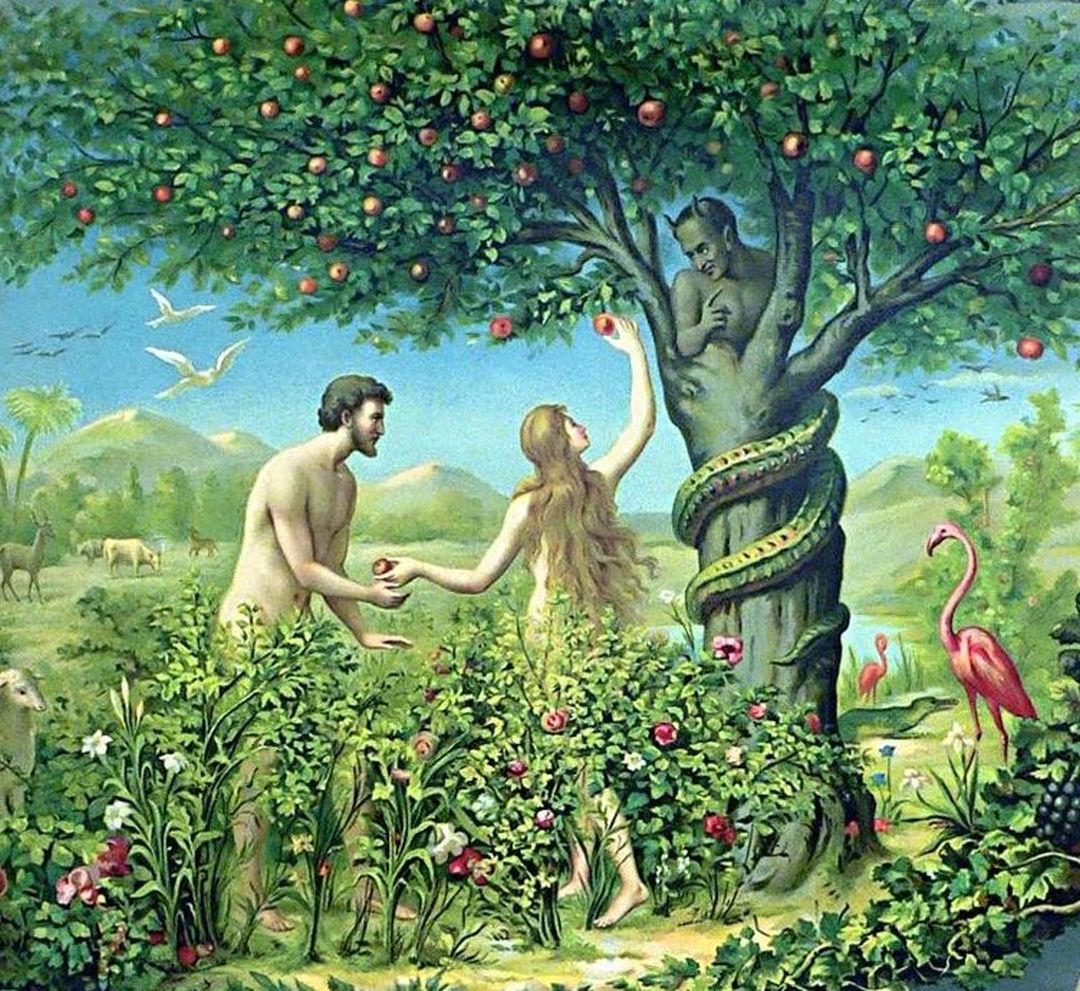
The tale of Adam and Eve and the garden of Eden has parallels with the Mesopotamians. This myth tells of an original paradise which is situated at the center of the world. Yahweh gives the commandment that all trees may be eaten except for one. However, the serpent succeeds in tempting Eve. God banishes the couple from paradise and condemns them to work for a living. Adams initiatory failure gave rise to the notion of “original sin” a central concept of Hebrew and Christian theologies and enforces the authority of Yahwistic monotheism. This first sin brought about the source of all evils that burden humanity. Eve gave birth to Cain a “smith” and Abel a “shepherd.” They gave their offerings and Yahweh accepted Abel’s over Cain’s. Angry, Cain killed Abel. Now Yahweh accursed Cain and drove him from the ground making him a wanderer of the earth. This myth reflects the simple and pure existence of nomadic herders and their resistance by dwellers in towns.2
The descendants of Cain and Seth lived very long lifespans- 800 or 900 years in length. Similar ideas are found in Greece and India with the age of heroes. After a certain time, their lifespans were shortened to 120 years. The greatest event of this period was the flood. Noah built an arc on Yahweh’s instructions and built it with representatives of the animal species. Only Noah, his wife, and his sons were saved. In these myths, a flood is sent to destroy the world so that humanity can be recreated and restored. The ancestors of Noah decided to build a tower with “its top reaching heaven”- the last incorrect maneuver. Yahweh came down and concluded that there will be nothing to hard for them to do and confused their language and scattered them over the earth. The redactors of the torah preserved a mythology of the traditional type but reinvented to form a new religious vision. This was transformed into a “sacred history” to an extent previously unknown.3
The Period of the Patriarchs
The latter half of Genesis involve the adventures of Abraham and Isaac and constitutes the period of the patriarchs. This period has been criticized as being fictional but some have been inclined to accept the reality of this tradition. Whether they are donkey breeders or caravanners, this text shares certain analogies with the institutions of the near east. This half of Genesis introduces a new religious experience which will become the religious experience peculiar to Judaism and Christianity. God lays down a series of instructions and makes a series of promises. The religion of the patriarchs is the cult of the father. He binds himself to a group of men who he binds and protects. On entering Canaan, the patriarchs were confronted by El of whom they identified with him which says there may have been structural similarities between the two. The patriarchs offered sacrifices, built alters, and set up stones; they also offered blood sacrifices.4
One ritual that was important to the Israelites involves dividing a heifer, goat, or ram in two- which has analogies elsewhere. But the main sacrifice found in Genesis is the sacrifice of Isaac. God demanded that Abraham sacrifice his son Isaac as a burnt offering; but when he was preparing the ordeal, a ram was substituted for him. This has been criticized as an idealization of history since the Canaanites had a similar procedure; but in the context of Genesis, the writers were more concerned with faithful transmission of tradition than with idealization. This episode illustrates more forcefully than any other in the old teastemant the meaning of Abrahamic faith. Abraham did not prepare to sacrifice his son for some purpose but simply based on faith even though he did not know why. However, Abraham never doubted the sanctity, perfection, and omnipotence of his god. Here we are presented with the dialectic of the “profane” being transmuted into the “sacred.”5
Moses and the Departure from Egypt
The beginnings of the religion of Israel are related to Genesis 46-50, Exodus, and the Book of Numbers. This includes the settling of Jacob in Egypt, the persecution launched by the pharaoh, the ordeals of Moses, his flight into the desert, the appearance of a “burning bush,” his mission laid out by God, the ten plagues sent by God, the departure of the Israelites and the crossing the sea, the theophany at mount Sinai, the forty years journeying in the desert, the conquest of Canaan under Joshua. Criticism has been made to separate the historical events in these sources from the mythological. certain events have been fitted with definitive dates but it has not been possible to recover the historicity of some of the most important events. There is no reason for doubting that Moses existed but many biographical details escape us. In any case, he follows the model of others in the age of heroes. The name Moses is Egyptian and perhaps of African descent. It is possible that Moses knew of the reform of Akh-en-aton, The departure from Egypt seems to reflect a historical event but perhaps construed with mythological excrescences.6
While keeping sheep for his father-in-law, Moses crosses the desert and comes to a mountain. He sees a fire coming from a bush and hears a voice claiming to be God. He declares to be the god of Abraham but Moses senses he is in the presence of something unknown. He reveals his mode of being but does not reveal his person. All Hebrews today accept him to be the god of Abraham. However, this god is likely to be a pure Yahwism. On the other hand, there are some indications of Yahweh merging with the god of the father. What is involved may not be pure monotheism since the existence of other gods is not denied. However, the struggle against false gods begins. Yahweh is conceived as anthropomorphic. He displays qualities and faults that are specifically human but does not reflect the human situation. The contradictory nature of some of these attributes aligns him with some of the divinities from Hinduism, for example. After the departure from Egypt the theophany took place on the mountain of Sinai. Yahweh dictated the laws of the covenant and gave Moses the two tablets. Nothing definite is known about this cult but may have shared similarities with preIslamic Arabs.7
The Religion of the Judges and Syncretism
The period from 1200 BC between when Moses entered Canaan and Saul was proclaimed king is known as the age of Judges. The judges were military leaders councillors and magistrates. Yahwism is accepted into other tribes and the Canaanite religion is absorbed into Yahwism. But also, during this time period, Yahwism evolves and changes. In consequence of the association Yahweh-El a number of Canaanite sanctuaries are consecrated to Yahweh. There was also a confusion between Yahweh and Baal. Part of the Canaanite sacrificial system was adopted. Sanctuaries are built on Canaanite models including massebahs (standing stones) and asherahs (wooden posts symbolizing Asherah). Among the ritual objects, we find teraphim (images or masks). The cult was organized around sanctuaries containing priests and next to them diviners or seers. Israeli ecstatic prophecy was deeply rooted in Canaanite religion. Even during the conquest there was a Canaanite influence even though the prophets lay claim to the purest Yahwism.8
 Idealism Studies