During the first two millennia, neolithic cultures developed, but without profound changes. However, from the fourth millennium, contacts with Sumeria brought about a mutation. Egypt developed new techniques including construction of brick, boat building, artistic motifs, and writing. Unlike Mesopotamia, vulnerable to invasion from every direction, Egypt was isolated and defended by deserts and seas. The Nile enabled the king to govern the country by a centralized administration. Thus, it came to be that the country was constituted by a rural mass ruled by an incarnate god- the pharaoh. The pharaohs were crowned and ruled for three thousand years. The pharaoh, incarnate god, established the new world- much higher and complex than the neolithic villages. Since he was immortal, his death meant his translation to heaven. The translation of one incarnate god to another insured the continuity of the cosmic order.1
Cosmogonies
The Egyptians adopted several cosmogonic myths. Some of the themes belong to the most archaic such as the emergence of a mound, lotus, or egg above the primordial waters. This emergence signifies the beginning of not only earth, but life, light, and consciousness. A certain sun temple at Heliopolis was identified with the primordial hill. Its lake was where the lotus emerged. Other versions recall the primordial egg which contained the bird of light. Or of the lotus that created the sun child or of the serpent who was the image of Atum. Others speak of a city in which Re created the first divine couple. In short, the Egyptian theogony and cosmogony involve creation by the power of thought and the word of a supreme god. We have here the highest expression of Egyptian metaphysical speculation. The myths involving the origin of man involve men being born from the tears of the solar god Re.2
The Role of The Pharoah and Life After Death
Re is the first king, and he transmits this function to his son and successor- the pharaoh. indeed, the pharaohs actions are said to be in line with those of the god Re. Res’s creation is said to put order in place of chaos and these same terms are applied to the pharaoh. The pharaoh is the incarnation of maat– which is translated as truth, but more appropriately designates good order, right, and justice. As an incarnation of maat, the pharaoh constitutes a paradigmatic example to all his subjects. The work of the pharaoh ensures the continuity of life. The pharaoh’s political activity repeats Re’s exploits; when the pharaoh wins in combat, it reproduces Re’s triumph. The cult was celebrated by the pharaoh, but was relegated to the priests of the different temples. The daily cult was addressed to the statue of a god in the temple. The priest performed a ritual purification, and then purified the statue.3
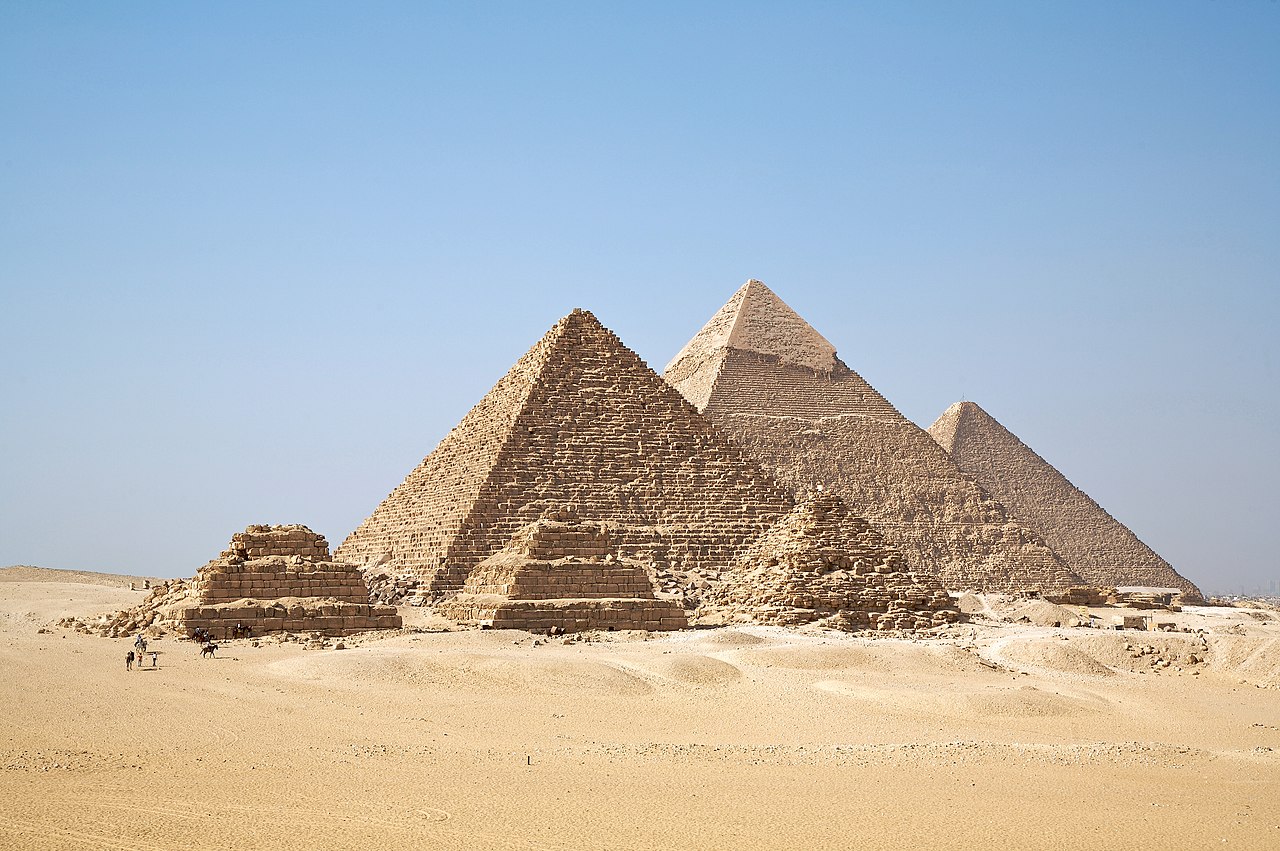
The Pyramid Texts reveal conceptions regarding the postmortem destiny of the pharaoh. The formulas state that the pharaoh cannot die and that his body will not suffer decomposition. Other formulas refer to the pharaohs celestial journey. He flies away in the form of a bird. Sometimes the king ascends to the sky by a ladder. Before arriving at the field of offerings, the pharaoh undergoes certain ordeals. The entrance is defended by a lake with winding shores and a ferryman. The pharaoh must then accomplish ritual purifications. Arrived in the afterlife, the pharaoh is received by the sun god and continues his earthly existence. He is seated on the throne and is surrounded by a number of his subjects. The Pyramid Texts are written in a poetry of exceptional quality and stress the privileged role of the pharaoh.4
Osiris and Developments in the Afterlife
Osiris was a legendary king who was murdered by his brother Seth. His wife, Isis, becomes pregnant with the dead Osiris. She burry his body and takes refuge in Delta and gives birth to Horus in papyrus thickets. Grown up, Horus revolts against his uncle. Seth removes one of his eyes but combat continues and Horus wins. He recovers the eye and gives it to Osiris who had returned to life. But Seth cannot be finally destroyed. Horus is then crowned king- his fathers legitimate successor. In the story, Osiris is always shown as powerless And passive. However, Osiris is reanimated as a vital energy. He will insure vegetable fertility and reproduction. Osiris, the murdered king, guarantees the prosperity of the kingdom ruled by his son, Horus. We can see the relation between re and the pair Osiris-Horus. The sun and tombs constituted two sources of sacrality. The pharaoh was re but was also horus. This cult was already popular in the old kingdom but became more popular in the classic period of Egyptian civilization.5
In 2200 BC, Egypt was shaken by civil war, the state collapsed, and anarchy entered the country. The period of anarchy was known as the First Intermediate period. It weas during this period that the “democratization” of the afterlife took place. People copied the pyramid texts that had been reserved exclusively for pharaohs and the pharaoh was accused of weakness and immorality. If the pharaoh no longer behaves like an incarnate god, things become doubtful including the meaning of life and the post existence of the soul. Men destroyed tombs, threw out the bodies, and carried off the stones. The downfall of traditional institutions brought about an agnosticism and a pessimism and a religious devalorization of death. Several new texts take up new views of the afterlife during this time. The compositions of the Intermediate Period continued to be copied long into the middle kingdom.6
Solarization and the Unsuccessful Reform
The middle kingdom experienced a period of economic expansion. During this time, Amon merged with Re to become Amon-Re- being identified with the sun. Because of this “solarization,” Amon became the universal god- overriding that of the Old and Middle Kingdoms. This was the result of the invasion by the Hyksos. The Hyksos imparted Syrian Gods- Baal and Teshub- whom they identified with Seth. A century later, the war of liberation began and the empire was reinstantiated. Thus began the decline of traditional Egyptian culture and an opening up to a cosmopolitan culture and foreign divinities. The solarization of Amon facilitated religious syncretism and the restoration of the solar god to the supreme rank. The worship of the solar god as the supreme god gave way to a religious unity. This solar theology was involved in political tensions and a struggle of power between the high priests and pharaoh.7
In 1300 B.C., Aton, the solar disk, was advanced as the supreme divinity by Amen-hotep to free himself from the high priest. The pharaoh removed the high priest of Amon’s powers and then changed his name to Akh-en-Aton. He abandoned the old capital and built a new capital just north where he built palaces and temples of Aton. The pharaoh made a number of innovations. He removed Amon and all other gods in favor of Aton, the supreme god. There has been discussion of the “monotheistic” nature of the reform. After the pharaoh died, his successor resumed relations with the high priest of Amon and returned to Thebes. The traces of the Atonist reform were mostly gone. This- the end of the eighteenth dynasty- marks the end of Egyptian creativity. Aton was worshiped long before the Atonist reform.8
Identification and the Book of the Dead
In the new empire, emphasis was placed on the complementary nature of opposed gods. Here Re is identified with Osiris. these two gods merge together in the dead pharaoh. Numerous texts emphasize the twofold aspect of Re: solar and Osirian. Re and Osiris are complimentary forms of a deity. These associations and identifications of gods were familiar to Egyptians from early antiquity. This identification reveals the complementarity between life and death. From the eighteenth dynasty, Osiris becomes the judge of the dead. A “trial” and a “weighing of the heart” takes place in the presence of Osiris. the Book of the Dead is the supreme guide to the soul’s journey after death. These books intend to facilitate the soul’s journey and ensure success in these ordeals- describing one’s descent through a subterranean world filled with obstacles. One of the most important chapters is devoted to the judgement of the soul in the great hall of two Maats. The deceased heart is suspended on one pan of a scale and the other is a feather or eye. The deceased must recite a prayer and make a declaration of innocence. This meditation on the mystery of death marks the last Egyptian religious synthesis. The twilight of Egyptian civilization will be dominated by magical beliefs and practices.9
 Idealism Studies