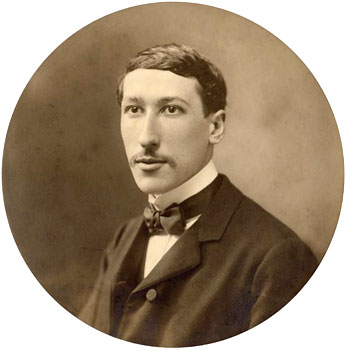
Rene Guenon (1886- 1951)
Early Days
Rene guenon was born November 15, 1886 to a 56-year-old father- Jean-Baptiste- and a 36-year-old mother in France. Guenon was entirely French in ancestory and his family owned a vineyard. however, by the time he was born, they were living in a small house in Bloise. When he was seven, they moved to a bigger house with a garden, which is where the formative years of guenon’s childhood were spent. Guenon suffered ill health as a child and his family was very religious. Guenon was talented in school, always coming first or second in the class. This was obtained all while guenon was experiencing frequent bouts of ill health and consequent time off school. Guenon soon became a loner among his peers and believed his teachers had it in for him. Because of this, Guenon moved to a new school in 1902, which had an excellent reputation. At this school, despite continued bouts of ill health, he continued to do very well and was particularly good at math, philosophy, and religion. Guenon entered the College Rollin to study advanced math in 1904, but he fell behind due to ill health and homesickness to the extent that he needed supplementary coaching. He left in 1906 and established himself in a small flat in the Ile St. Louis in Paris. The Ile St. Louis was in the center of Paris surrounded on all sides by a river. The flat had an interior courtyard and winding staircases. Guenons’ room had a spacious kitchen and dining room lit by gas and two bedrooms all with simply furnished rooms.1
Middle Years
Guenon’s decision to not obtain an academic position was a crisis point in his life. His admiration for philosophy and religion had been instantiated back in school. Now guenon attempted to access a more attractive and immediate form of metaphysical knowledge which led him to attempt to access the occult societies of Paris. At this time, Guenon was initiated into the Martinist order lead by Papus (real name Gerard Encausse) an energetic read bearded man some twenty years older than Guenon of French and Spanish descent based on the works of the Eighteenth-century Spanish philosopher L.C. de Saint-Martin. Guenon went to Papus’s school of occult studies based on a recommendation of a friend and Papus had himself been a student of the College Rollin. In 1908, Guenon began to fall out with Papus mainly because he wished to revive the Order of the Temple. There were three more main organizations which appealed to both the general public and the occultists of France: the theosophical society of America, the spiritualism of America and France, and the freemasonry of England. Guenon was attracted to certain fringe masonic groups and spiritualist movements but eventually turned away from them.2
By this time, Guenon began to fall out with Papus along with two of his close friends: Champrenaud and Pouvourville. Guenon founded a periodical called La Gnose with these two when he was initiated in 1912 into a Sufi order lead by al-Kabir. Guenon made translations of important Sufi mystical texts and continued to work on La Gnose. Guenon’s interest in the Hindu doctrines had been stimulated by his contacts with the theosophical society which is linked to Indian philosophical teachings though much adulterated by madame Blavatsky’s vision. However, the Vedanta was now somewhat popular in Europe. Guenon claims to have received his teachings directly from Hindu masters. Back in 1912, Guenon also married a young woman who was an assistant to his aunt. The marriage was Catholic as Guenon was still Catholic.3
Publishing of Main Works
From now von, Guenon’s life changed because he now had family responsibilities and had to earn a living, but also because he increasingly disapproved of the occultists of his time. He retained his interest in masonry and became affiliated with the Thebah lodge associated with La Grande Loge de France. The following year we find him associated with a leading anti-masonic writer: Abel Clarin de la Rive. Anti masonry was initiated into the public by Taxil some 40 years earlier. He revealed, for example satanic rites practiced by masons which in actuality may have had nothing to do with masonry. Guenon was initiated into an anti-masonic magazine through his contacts with La Gnose. Many have commented on Guenon’s writing for an anti-masonic magazine while being a member of a masonic organization, but Guenon’s approach to masonry was idealistic. guenon seems to have retained a belief in masonry as a preserver of the primordial tradition.4
During the first world war he was exempted from military service due to poor health and had to take up teaching in order to pay the rent. He taught at a high school during the 1915-16 years and after his mother died in 1917 was appointed lecturer in philosophy at Setif in Algeria. In 1918, he returned to France and settled with his wife and aunt in his old family home in Bloise and was appointed lecturer in philosophy at his old school. Guenon was introduced to a circle of young philosophy students who had gathered around the Institut catholique de Paris. By this time, Guenon had ceased to be the wild occult experimenter of his youth and was now an academic bourgeoise engaging in intellectualism. During this time, guenon wrote his first book Introduction to the Study of the Hindu Doctrines which was submitted for a doctorate but was rejected since it failed to display the sort of evenhanded documentation required for such theses. Nonetheless it was accepted for publication. In 1921, guenon published Theosophy: History of a Pseudo-Religion. This book was exceedingly well documented although much more is now known about the ludicrous and fantastic side of the religion.5
Guenon life now began to change in that he now became increasingly absorbed in his writings. During this time guenon published several new books including The Spiritist Fallacy in 1923 and East and West in 1924. This helped Guenon gain some readers, but he was still being somewhat ignored by both the general public and academics. In 1924, Frederic Lefevre, editor and chief of a prestigious religious journal decided to hold a press conference with some leading religious experts of the time. Rene Grousset, an expert on China, Jacques Maritan, a Christian neo-Thomist, and Rene guenon, and expert on Hinduism, were invited to take part. One more event to be noted is Guenon’s relationship with the journal Regnabit– a Christian religious journal. Here, guenon developed some of his ideas on symbolism. From 1924 onwards, Guenon taught at a private all-girls school. However, in 1928 Guenon’s wife died and nine months later his aunt died. His supporters tried to keep him tied to the catholic religion but this double blow caused him to seek to eventually retreat into the safe haven of the east.6
Later Years
Guenon was not good at being a bachelor, and needed the support of a wife and a secure home background. He attempted a second marriage, but was refused. Thus in 1930, he made the decision to travel to Egypt with a wealthy widow- madame Dina- planning to found a publishing house there to translate original texts illuminating the primordial tradition. Three months later, madame Dina returned to France and the plans for the publishing house folded. Guenon stayed and by 1931 was publishing in an Arab periodical. Guenon moved to a modest house opposite a university and abandoned western clothes for an Egyptian style of dress. In 1934, he married the daughter of a Muslim lawyer. The couple moved to a few different houses and settled in 1937 to a comfortable house in a suburb with a distant view of the pyramids but moved back to the center of Cairo in 1946 and had four children. His time in Cairo was mainly spent on study and writing. Guenon eventually converted to Islam but maintained that it doesn’t imply the superiority of one tradition over another as they all are reflections of the primordial tradition. During this time, Guenon published several new books including The Multiple States of Being in 1932, The Reign of Quantity and the Sign of the Times in 1945, and The Metaphysical Principles of the Infinitesimal Calculus in 1946. In 1945, Guenon developed a persistent cough and eventually died in 1951.7 More books from Guenon have been published posthumously.
 Idealism Studies