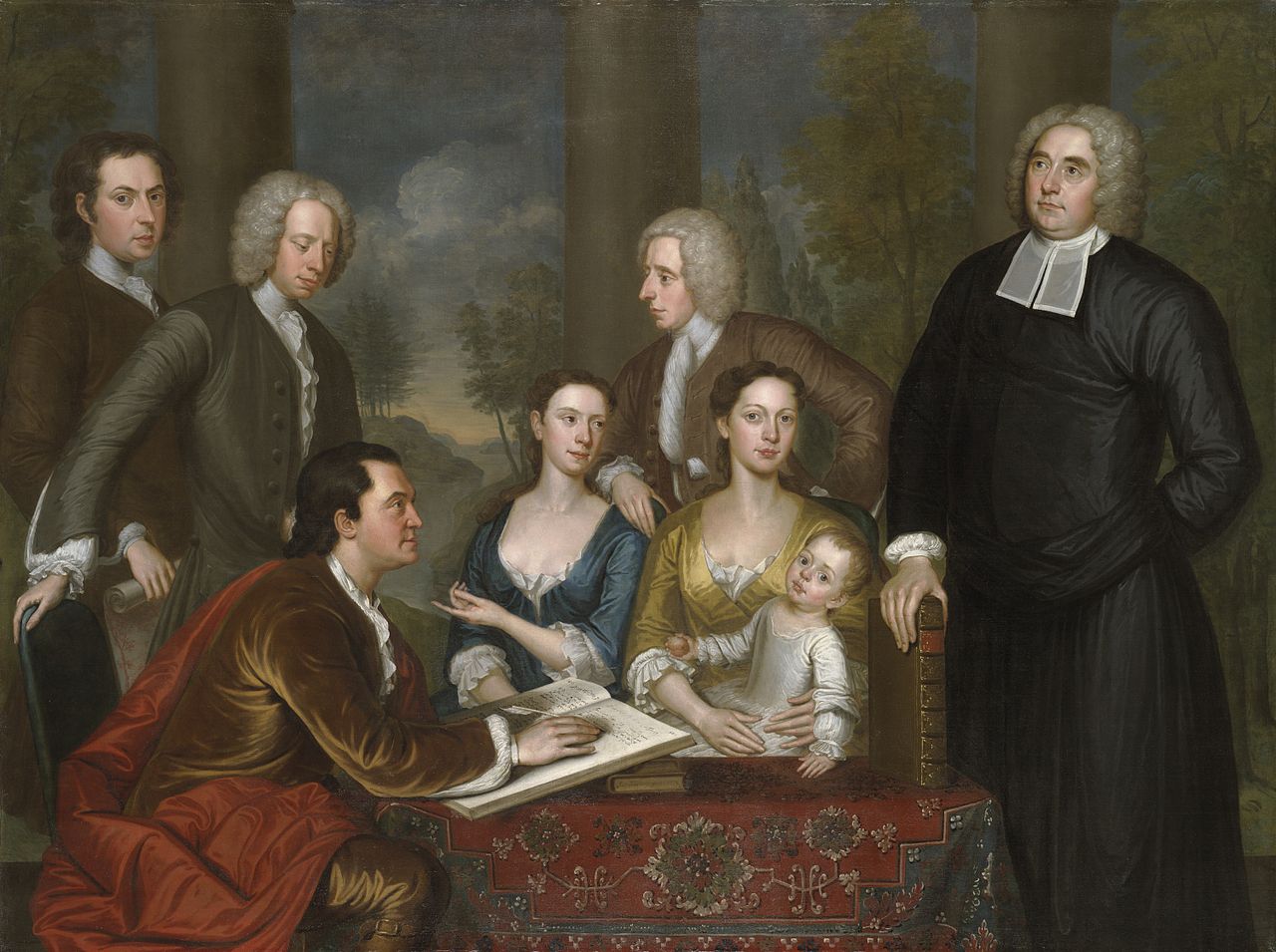
Berkeley and his entourage
George Berkeley (1685-1753) was the 18th century idealist from England. He is generally considered to be the second of three in the line of British empiricists starting with Locke and ending with Hume. Berkeley, although probably taking inspiration from Averroism, was the original Western idealist.
Early Years
George Berkeley was born the eldest of six sons in 1685 in Ireland to and English father and an Irish mother. Berkeley went to a prestigious secondary school and was known to be a daydreamer as a child. Berkeley entered Trinity college Dublin in 1700. There Berkeley experienced the new philosophy of Newton, Locke, and Hobbes and became equated for the first time with the ideas of the freethinkers- a group of minds that were against metaphysics. In 1704, Berkeley wrote An Essay Towards a New Theory of Vision. In the book, Berkeley argues that distances perceived in space are an illusion. All inferences of distance based on optic axes from the object to the eye are not actually perceived but are inferred from fluctuations in movement. Thus all notions of distance simply signify that if one were move toward such and such an object, then he would experience it through touch.
In 1709, Berkeley was ordained a deacon. In 1710, Berkeley wrote his second and main book: Treatise Concerning the Principles of Human Knowledge. In it, Berkeley argues that the world must be contained within mind or spirit. To say, for example, that a chair exists in another room simply means that if one were to go into another room under such and such a circumstance, he would see it. Berkley uses his claim to demonstrate the existence of God and the existence of the soul. Treatise was received with mixed reviews with many people misconceiving what Berkeley had to say. Many took Berkeley to be denying a sensible world, which Berkeley in fact confirmed- albeit a world contained in a mind.
In order to settle these misconceptions as well as expand upon the Principles, Berkeley wrote Three Dialogues between Hylas and Philonous in 1712. In the book, Berkeley develops several new arguments. Among them are the assimilation argument which argues that qualities such as heat are indistinguishable from sensations such as pain, and so the qualities must be dependent on the perceiver and the argument for conflicting appearances which argues that if there is no perceptual error, then the conflicting perceptions reveal the mind-independent world to be inconsistent.
In order to print and commercialize his book, Berkeley traveled to London in January 1713 to meet “men of merit.” Berkeley wrote to his colleague that he enjoyed the views of rural England on his trip to London much more than anything in London itself. Berkeley met many famous intellectuals in London including Steele and Addison. Berkeley had a good time in London. Berkeley’s three dialogues was published in June, and we find Berkeley in Oxford. Berkeley then spent ten months in France and Italy in the suite of Lord Peterborough. Thus began Berkeley’s 20 years of travel and social activity in which metaphysics and authorship was in the background. There Berkeley met, for example, Malebranche- the French philosopher.
Middle Life
In 1723, Berkeley made the decision to sail to Bermuda with several of his close freinds from London. Meanwhile, Berkeley received funds from his patent and from a diseased woman who decided to leave her fortune in his name. In 1728, Berkeley married Anne, a daughter of a chief justice of the house of commons. They sailed to Rhode Island that year with a small entourage. Pictured is a portrait taken by Smibert (pictured left) of Berkeley and his entourage. Berkeley stayed with his wife for several years in Newport in a farm house with a view of orchards and the ocean in the distance- mixing with the people of Newport occasionally. It was at this estate that Berkeley wrote Alciphron– Berkeley’s main book on the philosophy of religion. In the book, Berkeley argues that religious beliefs are a type of belief that goes beyond what is received through nature. Moreover, virtue and faith in God are consistent with happiness. Belief in beauty and goodness are inadequate for the highest good and something higher is needed to direct us. Berkeley then goes on to discuss his famous doctrine in which the universe is given to us in a visible language. Finally, Berkeley argues that Christianity is the highest form of religion. Berkeley returned to London in 1732. Many of his friends from his early years had now died including Steele and Addison.
Later Years
In 1734, Berkeley was ordained a bishop of Cloyne. At Cloyne, Berkeley was almost as removed from the world as he was at Rhode Island- Cloyne being 20 miles from Cork. Berkeley then spent 18 years in Cork- serving the diocese. Berkely enjoyed his surroundings- mainly the Irish and a small group of English settlers. Meanwhile, Berkeley’s philosophy was finally beginning to receive detailed attention. At this point, famine and disease were widespread in Ireland, and because of this, Berkeley began to study the medical values of tar water. Berkeley thus wrote Sirus: Inquiries Concerning the Virtues of Tar Water. Berkeley, here, discloses his idealism in mature form mixed with his analysis about tar water. Tar water is a medical substance that can cure disease. Similar to work in the Greek vein, tar water works through interaction with the non-mechanical fire and aether that permeates the cosmos. Thus, tar water can be seen as a form of alternative medicine.
Berkeley had three sons; one died young, the second did not live very long after Berkley died and the third became a student at Oxford. In 1752, Berkeley went to live in Oxford. He was becoming weak at this point. Not much is known of Berkely’s life at Oxford. At some point, Berkeley’s health improved and he even began to study again. Berkeley died in 1753.
 Idealism Studies