(Revise) (Add picture)
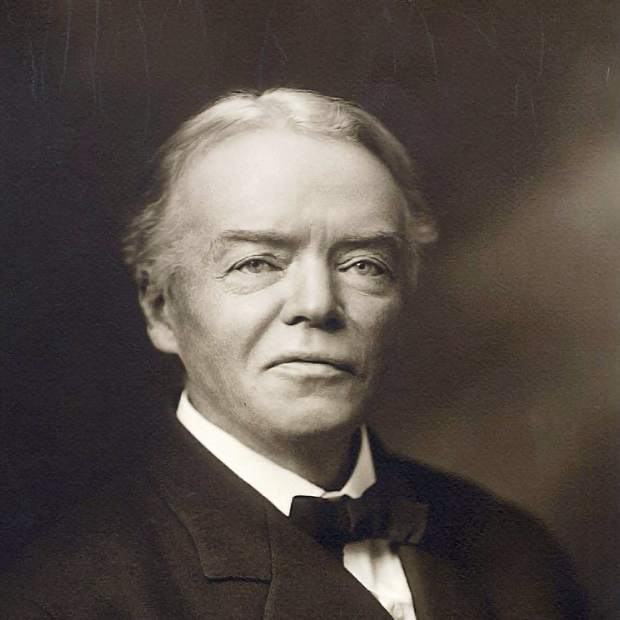
Josiah Royce (1855-1916)
In his book Appearance and Reality, F. H. Bradley gives a conception of the absolute as an abstract monism. The argument is that between any two objects of experience, such as a glass and a container sitting next to each other, there must be a relation between the two such as that one is taller than the other. This creates a relation between that relation and the original objects and a relation between that relation and the original objects and so on leading to an infinite regress. Thus, what is real is a relationless abstract monism in which unity and diversity hold, but of which it is impossible to know how this university and diversity interact. In order to refute Bradley, Royce compares the infinite regress of relations to the whole number sequence, which forms a self-representative system.
But how is it possible for reality to be both determinate and infinite? The answer is that the actual infinite must be a possible that is nowhere present to thought. In order to see how the infinite is a concrete conception, the infinite will have to be a determinate infinite in which what is only concerned is the relation between the object and thought, taken without external meaning. There are thus infinitely many ideas that are from the absolute perspective contrary to fact. Royce agrees with Bradley that no infinite is determinate which looks for an object without end. However, the endless series is presented only as a negatively presented result. However, this infinite series is presented all at once to the absolute. For example, consider the ordered series of whole numbers 1, 2, 3, . . . and those numbers raised to the rth power. Then there exists a unique rth member in the sequence of numbers that are squared or numbers that are cubed and so on. This is a one-to one relation of the whole numbers to their 1,000th power in such a way that if you attempt to take the 1,000th power of 80,000,000 by hand, the result is left as a bare possibility. It is mathematically fixed, but left as a negatively presented result. Unlike Bradley’s infinite the individual members are themselves determinate. But the question now remains what to make of the whole- is it simply a formless, and unindividuated realm, where chaos reigns? No for three reasons: first the whole must conform to an ideal definition, the whole must remain the limit of what is obtained in individual experience, and third the whole must be such that no other type would meet the purpose.
 Idealism Studies